
Installing Electrical Panel in Greenville: Complete Guide
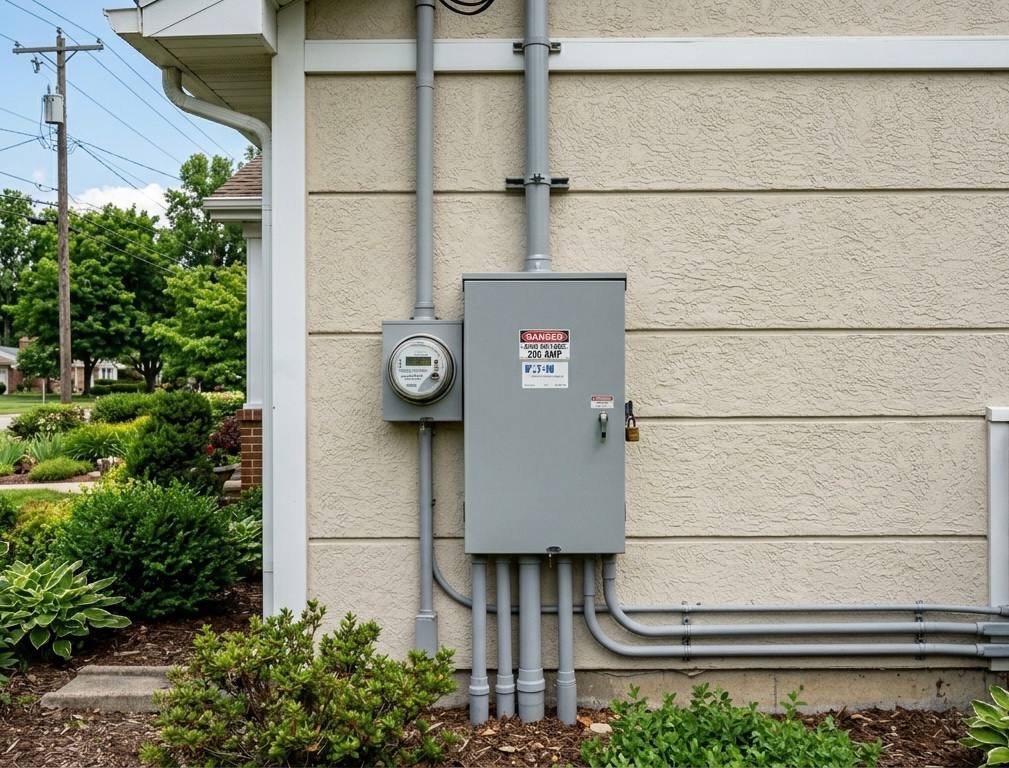
Your electrical panel is one of the most important components inside your home or business. Every day, it quietly manages the flow of electricity throughout your entire property, keeping your lights on, your appliances running, and your systems powered. For homeowners and businesses across Greenville and Spartanburg counties, understanding what an electrical panel does, how it works, and what it takes to install or replace one is essential knowledge before starting a project of this scale.
This guide was put together by Redland Electric, a licensed electrical contractor serving Greenville and the surrounding Upstate South Carolina areas. Inside, you will find a full breakdown of the electrical panel, its components, South Carolina's legal installation requirements, a step-by-step overview of the installation process, the differences between residential and commercial installations, and guidance on choosing the right electrician for your project. If you are searching for information on electrical panel installation in Greenville, or you are simply trying to understand what the process looks like before reaching out to an electrician, this article was made for you!
What Is an Electrical Panel and What Does It Do?
The electrical panel of your property is the central control system that manages your entire electrical supply. From the moment electricity enters your home or business from the utility company's service line, the electrical panel takes over. The power first passes through a meter that records usage, and from there it enters the panel. The panel then receives that power and distributes it to every part of your property through a network of individual circuits.
Each circuit is responsible for powering a specific area or system. One circuit may power the outlets in your kitchen, another may control your HVAC system, and another may handle the lighting in your bedrooms. These circuits carry electricity through wiring that connects to devices, appliances, and systems throughout your entire property.
The electrical panel is not just a distribution hub. It also acts as a safety mechanism. It continuously monitors the electricity flowing through your property and protects the system from overloads caused by too many devices running at once, short circuits caused by damaged wiring, and power surges caused by storms.
There is no overstating how essential the electrical panel is. It is, quite literally, the brain of your Greenville home's or business's electrical system. Remove it, and your property has no power at all. This is why electrical panel installation is one of the primary electrical services an electrician provides to newly built homes and commercial properties.
Components of an Electrical Panel: How It Works
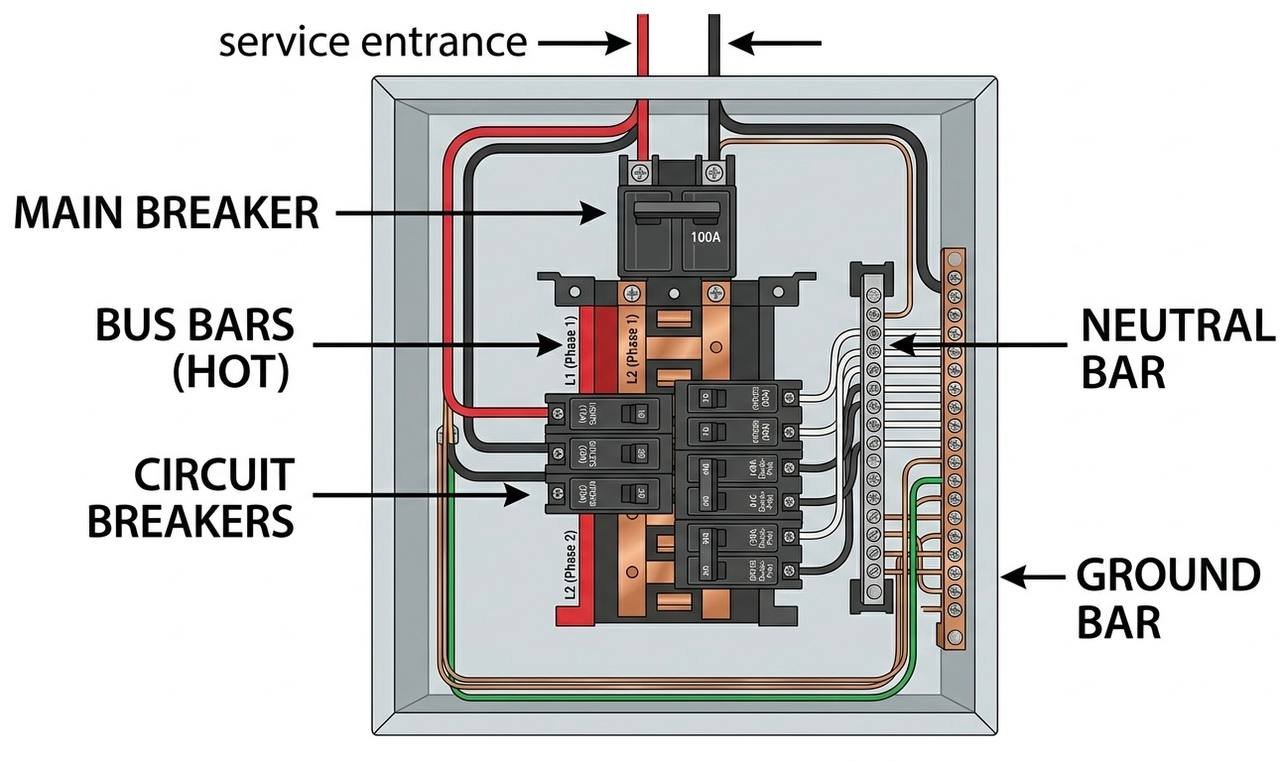
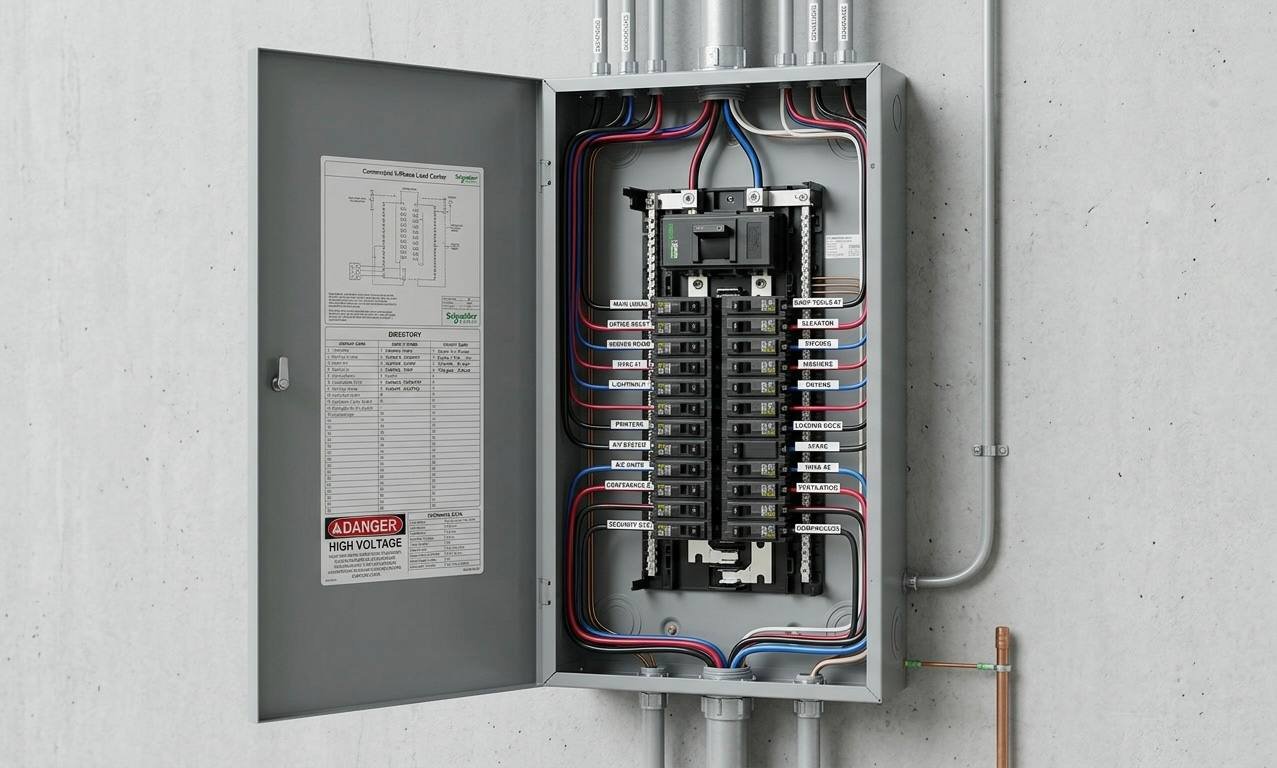
To fully understand your electrical panel, it helps to know what is inside it and what each component is responsible for. A standard electrical panel has four primary components.
The Main Breaker
The main breaker is the component responsible for managing the total amount of power being received by the building. It controls the overall power load entering the panel. The main breaker is also the component used to shut off power to the entire property in cases of an emergency or during electrical work.
Circuit Breakers
Each circuit breaker controls a single circuit. If too much electricity flows through a circuit, the breaker trips and shuts off the power supply to that specific circuit. This prevents overheating and reduces the risk of fire. A circuit breaker is a safety mechanism built into your electrical panel that protects both your property and the people inside it.
Bus Bars
Bus bars are the small metal strips located inside the electrical panel. They are responsible for distributing the power received from the main breaker and delivering it to each individual circuit breaker. They act as the connectors that make the flow of electricity through the panel possible.
Neutral and Ground Bars
The neutral and ground bars are responsible for returning unused electricity and stabilizing the electrical system. They help reduce the risk of electrical faults and system overloads, keeping your electrical system balanced and safe.
Once electricity enters the panel, it is divided into circuits, and each circuit carries that power through wiring to different parts of your property. This is also why the condition of your home or business's wiring is so important. Damage to a circuit's wiring means loss of power to whatever area or system that circuit serves.
Understanding Electrical Panel Capacity
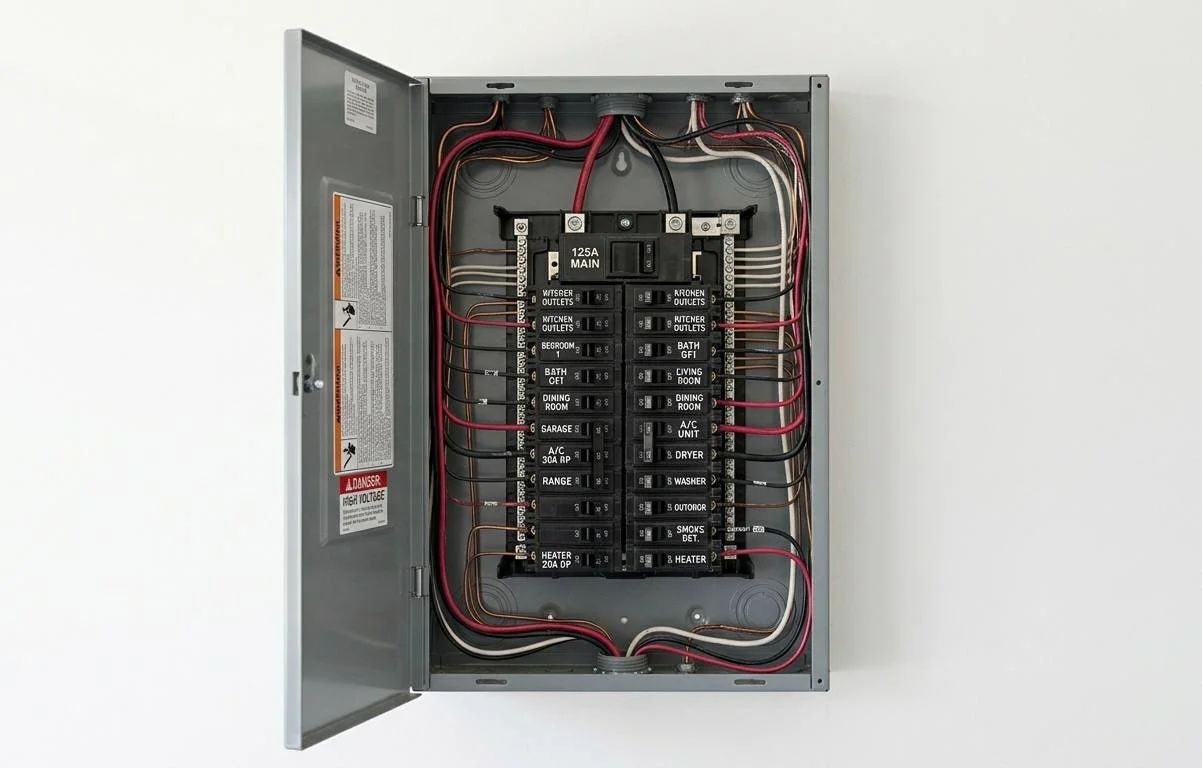
Every electrical panel has a capacity rating, which is measured in amps. This rating determines how much electricity the panel can safely manage and distribute at one time.
Older homes in Greenville and surrounding areas often have panels rated at 100 to 150 amps. For modern appliances, electronics, and systems, that is often not enough. Most newer homes and homeowners who choose to upgrade their panels in Greenville receive a 200-amp electrical panel. A 200-amp panel can safely and efficiently power air conditioning systems, kitchen appliances, home offices, EV chargers, and much more. The 200-amp panel has become the standard for residential properties over recent years, while larger properties are now installing panels rated at 250 to 300 amps.
For commercial properties, the demands are significantly higher, and panels are sized accordingly. We will cover that in more detail in the commercial section of this guide.
During the initial consultation, a licensed electrician will inspect your property and calculate exactly how much power capacity your panel needs. If your current panel is undersized for your load, your breakers will trip frequently and the system can become unsafe to operate.
Legal Requirements for Electrical Panel Installation in Greenville, SC
Installing a new electrical panel in Greenville is not a quick weekend project. It is a process that involves permits, inspections, and legal requirements set by both the state of South Carolina and Greenville County. Here is everything a homeowner or business owner needs to know before the first wire is touched.
The National Electrical Code (NEC)
Greenville County follows the National Electrical Code, which is the baseline standard for all electrical work performed in the area. Any electrical panel installation in Greenville must comply with the standards set by the NEC. This includes grounding requirements, circuit protection, installation practices, and the materials used. If you have hired an electrician or electrical contractor for the project, they are legally required to follow NEC standards throughout the installation.
Permit Requirements in Greenville County
One of the most important legal requirements for electrical panel installation near me searches in Greenville is obtaining a proper permit before any work begins.
Greenville County requires a permit for any electrical upgrade, installation, or repair. This includes installing a new electrical panel, upgrading to a higher amp panel, replacing components of an existing panel, and routine maintenance involving the panel. Your licensed electrician will typically handle the permit application on your behalf through Greenville County Building Safety.
You can also submit a permit application directly on the Greenville County website.
After submitting the application, Greenville County Building Safety typically responds within 1 to 3 business days. Larger projects, commercial installations, and service upgrades that require utility coordination may take longer and may involve a more detailed review.
Permit Fees for Residential Properties in Greenville County:
Electrical panel replacement: $36.00
Each additional circuit: $3.60
Additional fees may apply based on amp size
Permit Fees for Commercial Properties in Greenville County:
Minimum fee: $72.00
Panel replacement only: $36.00
New service or service changes: $0.48 per amp
Per circuit: $3.60
Your electrician will usually help you navigate the permit fees and throughout the entire process. Staying in close communication with your electrician during the permit process is important. Delays in providing necessary details or documentation can push back the entire project timeline.
Code-Compliance Inspections
Every permit issued in Greenville County requires a follow-up inspection. Once the electrical panel installation is complete, a county inspector will come to the site and review the work to confirm it meets all code requirements.
The newly installed panel cannot be legally operated until it passes inspection. If the installation does not pass, corrections must be made and the system must be reinspected. In most cases, inspections are scheduled by the electrician through Greenville County Building Safety and typically occur within 1 to 3 business days of the project being marked as complete. The majority of electrical projects in Greenville are inspected within the same week of completion.
Keep in mind that your utility company will likely require both proof of permit and proof of inspection approval before activating service to your new panel. The panel cannot simply be turned on once it is installed.
Additional South Carolina Electrical Code Requirements
South Carolina enforces several additional NEC standards that are relevant to the panel installation process. GFCI protection is required in areas such as bathrooms, garages, and outdoor spaces. AFCI protection is required in living spaces such as bedrooms and living rooms. Modern panels must be capable of supporting these protections, which means the installation may also involve updating specific breakers and verifying that circuits meet current safety standards.
Why Only a Licensed Electrician Can Install an Electrical Panel
Unlike minor home repairs, electrical panel installation is a task that legally requires a licensed and insured electrician. Permits in Greenville County are typically only issued to licensed electricians, and the NEC requires that panel installations be performed by authorized personnel.
Beyond the legal requirements, consider what the panel actually does. It controls every ounce of electricity flowing through your property. Installing it incorrectly carries serious risk of electrical failure, fire, or injury. This is not a task comparable to changing a light fixture.
If you are looking for a panel installer near me in Greenville, take the time to verify the credentials of the company or electrician you are considering. Confirm that they are licensed and insured, check their reviews, and ask about their prior experience with electrical panel installations. An experienced electrical contractor in Greenville will know the local codes, understand how to pass Greenville County inspections, and know exactly what materials perform well in Upstate South Carolina's climate.
Unsure of what questions you should be asking an electrical contractor before hiring? Check out our article "8 Essential Questions to Ask Your Greenville Electrical Contractor", where we share 8 questions you should ask electrical contractors to help you choose the best one for your home or commercial electrical project.
The Electrical Panel Installation Process: Step by Step
Below is a detailed overview of how electrical panel installation in Greenville is typically approached for both residential and commercial properties. This overview is designed to help you prepare for the project, understand what to expect, and know what questions to ask your electrician.
-
The process begins with a licensed Greenville electrician performing a full inspection of your current electrical system. The electrician will assess the service size, grounding condition, the overall state of your electrical system, and determine the correct load for your property. This includes inspecting your HVAC system, appliances, square footage, and future electrical demands. The result of this inspection is a precise load calculation that determines the correct amperage for your new electrical panel.
-
After the inspection, the electrician puts together a detailed scope of work. This includes the panel size, meter base condition, grounding upgrades, surge protection, and any service upgrades required. From this, a full project estimate is created that clearly breaks down materials, labor, and any additional costs before work begins.
-
Before any physical work starts, the electrician submits an electrical permit application on your behalf to Greenville County Building Safety. This is a legal requirement and a step that cannot be skipped.
-
The electrician contacts your utility provider to shut off service to the property for the duration of the installation. This ensures the work is carried out safely with no live power flowing into the system.
-
The electrician gathers all materials needed for the installation, which may include the new panel, breakers, grounding equipment, wiring, and circuit components. Each circuit is clearly labeled, and the installation area is prepared before work begins.
-
If you have an existing electrical panel being replaced, the old panel cover is removed, branch circuits are disconnected, and any outdated wiring is replaced. The area is cleared and prepared for the new panel.
-
The new electrical panel box is safely mounted in accordance with clearance, height, and space requirements set by code. If the grounding system requires an upgrade, that work is performed at this stage. Ground rods, bonding jumpers, and grounding electrode conductors are installed or replaced to meet current code requirements.
-
The main breaker is installed and the service entrance conductors are connected. All connections are tightened to manufacturer specifications to prevent overheating or failure over time.
-
Each circuit is connected to the new panel. If circuits were previously connected to an old panel, they are carefully reconnected. Proper breaker sizing is verified for each circuit, and wire terminations are organized to maintain a clean and code-compliant layout inside the panel.
-
Whole-home surge protection is installed either inside the panel or as a dedicated breaker. This is an important layer of protection for your electrical system and the devices connected to it.
-
A clear and accurate circuit directory is created inside the panel door. Each breaker is labeled to identify exactly which area or appliance it controls, making future troubleshooting and maintenance far easier.
-
The electrician performs a thorough review of all connections, verifies torque specifications, checks grounding continuity, and confirms everything is code-compliant before power is restored to the system.
-
The utility company is contacted to restore power. Once live, the electrician tests voltage levels, breaker operation, and circuit functionality. Major appliances and systems are checked to confirm everything is operating as expected.
-
Greenville's local building inspector reviews the installation to confirm compliance with local codes and permit requirements. The system cannot be officially placed into service until this inspection is passed.
-
Once the inspection is passed, the homeowner or business owner receives full documentation, including permit records, inspection approval, warranty information, and panel details. The electrician walks you through the newly installed panel, answers any questions, and shares operating safety tips and maintenance guidance.
Throughout every stage of this process, communication between you and your electrician is essential. A reliable electrician will keep you informed at every step, from permit submission to utility coordination to inspection scheduling.
Residential vs. Commercial Electrical Panel Installation in Greenville
The core process of installing an electrical panel is the same for residential and commercial properties, but the scope, complexity, and requirements are very different.
Power Demands
Residential electrical panels in Greenville are typically rated at 200 to 300 amps and use single-phase power. Commercial electrical panels, on the other hand, operate on three-phase power and are often rated at 500 amps or more. Larger commercial facilities can require panels exceeding 1,000 amps. In some cases, a commercial property may need multiple electrical panels installed due to the size of the building and the complexity of its wiring.
Permitting and Plan Review
For residential electrical panel replacement in Greenville, the permit process typically takes 1 to 3 business days. Commercial installations are a different story. An electrician handling a commercial project must submit a full detailed plan for review, including electrical drawings. In some cases, engineering documentation is also required. Commercial permit review in Greenville County can take 1 to 2 weeks, and the county may request additional drawings from your electrician even after the initial submission.
If your commercial space exceeds 5,000 square feet, South Carolina State Law requires that a design professional oversee the project. The same requirement applies if your commercial space is classified as assembly, educational, institutional, or hazardous occupancy. Residential panel installations rarely involve engineers or designers, but commercial installations frequently do.
Installation Complexity
Commercial electrical panel installation in Greenville requires precise load calculations, and even after those calculations are completed, it is highly recommended that the panel be sized to handle a load slightly above the calculated demand. Commercial panels operate continuously, and the margin for error is smaller.
Commercial installations frequently require coordination between electricians, engineers, architects, inspectors, and construction teams. Industrial-grade materials and heavy insulation are used throughout the process. Multiple inspections are required to confirm full safety compliance. A commercial installation must meet NEC standards, OSHA safety requirements, and local fire and life safety codes.
Commercial electrical panel services in Greenville for commercial properties are phased projects that can take weeks to complete. They are not single-day jobs. They require full expertise, careful planning, and detailed documentation at every stage.
Redland Electric: Electrical Panel Installer in Greenville
If you have been searching for an "electrician near me" or "electrical services near me" in Greenville, Redland Electric is the company you have been looking for. Redland Electric provides electrical panel installation and replacement services to homeowners and businesses across Greenville County, Spartanburg, Anderson, and surrounding areas in Upstate South Carolina. Every electrician on our team is licensed, insured, and bonded. Our company is led by David Tkach, a local Master Electrician with years of hands-on experience helping Greenville homeowners and businesses manage their electrical needs. Our team holds over 25 years of combined electrical expertise and handles projects of all sizes, from outlet additions and custom lighting to full home wiring and complete electrical panel upgrades in Greenville.
If you are curious to learn more about electrical panel upgrades, we recommend checking out "Electrical Panel Upgrade: Guide for Greenville Homeowners" where we share common electrical panel upgrades, when you should upgrade your electrical panel, the step-by-step process of upgrading the electrical panel and how much electrical panel upgrades cost.
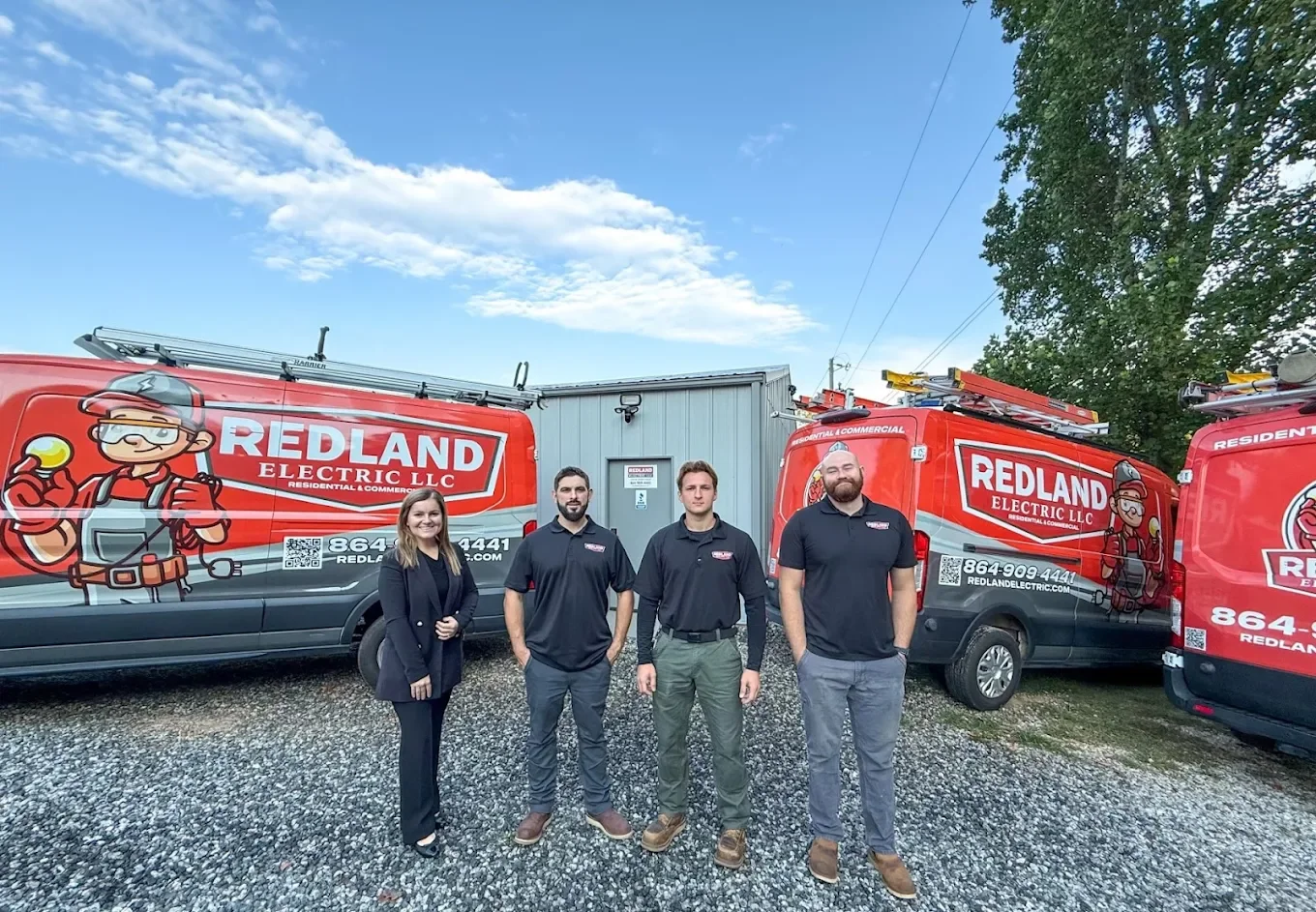
Electricians that live in this community. We genuinely care about keeping homes and businesses across Greenville powered safely and reliably. Here is what you can expect when you work with Redland Electric on your home electrical panel installation or commercial project:
Transparent Pricing: Our electricians provide a full project breakdown before any work begins. You will see the cost of materials, labor, and any additional charges upfront. No surprises.
Clear Communication: We communicate with you throughout the entire process. From permit submission to utility coordination to inspection scheduling, you are kept in the loop at every stage.
Local Code Knowledge: Our electricians understand Greenville County's codes, inspection standards, and permit requirements. We install electrical panels correctly the first time so your project passes inspection without delays.
Customized Quotes: Every property is different. Your quote is built around your specific property, your electrical demands, and your project scope. You will never receive a generic, one-size-fits-all estimate from us.
Clean, Professional Work: After the electrical panel installation is complete, we clean up, report back to you on everything that was done, and walk you through your new panel. We also share safety and maintenance tips so you are fully prepared to operate your new system.
Safely installing and servicing circuit breaker panels in Greenville for residential, commercial, and industrial clients for years. If you are ready to move forward with a new panel installation or replacement, or if you simply have questions and want to talk through your project, reach out to Redland Electric today and schedule a consultation with one of our licensed electricians!